Certain versions of the ZeroG installers have a serious issue when installing software on the Linux desktops. You start seeing a variety of errors like
"/bin/ls: error while loading shared libraries: librt.so.1: cannot open shared object file: No such file or directory"
... and many others, while you can very clearly see that the library files are present on the file system.
I face the same issue while installing Oracle Calendar desktop client on my FC 5 Linux distro. When i started googling for the errors encountered, i started to see a lot of rather half-answered posts which did not work for me. Sufficient enough to piss me off, i started debugging the installer by setting the debug param to true.
>LAX_DEBUG=1 sh cal_linux
This gave me some leads and i finally figured that there was some kind of work around being applied because the installer kept thinking that the JVM being used had a version less than 1.4, which was inturn caused by the fact that the installer was setting the LD_ASSUME_KERNEL variable to 2.2.5 ...
The version information was pulled of from a set of variables called v_major, v_minor, etc.. Fix these values and you are good to go :)
>v_minor=4 sh cal_linux
voila!! the installation goes through smoothly :)
If you would like to further customize the installation by specifying the JDK to be used, then you could achieve the same by the following command:
>v_minor=5 sh cal_linux LAX_VM /usr/java/jdk1.5.0_06/bin/java
Hope that helps you folks out there.
Thursday, April 06, 2006


Saturday, April 01, 2006
Connecting your Nokia 2112 with your Fedora Core 5
Here is a quick and dirty hack for connecting your Nokia 2112 CDMA phone to your linux box as an internet modem.
My hardware / software details:
* Fedora Core 5
* Nokia 2112 CDMA phone
* CA-42 cable.
Upon connecting your phone the usual response in the messages log is:
drivers/usb/class/cdc-acm.c: This device cannot do calls on its own. It is no modem.
None the less, register it as a modem.
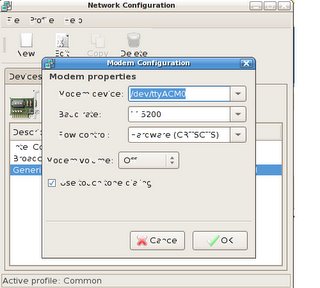
Now go ahead and create a new internet connection based on this modem. Specify all the connection information (username, password, dial in number, etc.)
Now the last step :)
Open up your /etc/wvdial.conf file. In here you need to get rid of the +FCLASS option. Just remove this word from the init parameters, and that is it.
Now you should be able to connect to your internet :)
Have fun!!
p.s.: At times the wvdial.conf file keeps getting overriden. You will notice this everytime you get an error code of 8. If you get this error code, then just repeat the last step of removing the +FCLASS statement.
My hardware / software details:
* Fedora Core 5
* Nokia 2112 CDMA phone
* CA-42 cable.
Upon connecting your phone the usual response in the messages log is:
drivers/usb/class/cdc-acm.c: This device cannot do calls on its own. It is no modem.
None the less, register it as a modem.

Now go ahead and create a new internet connection based on this modem. Specify all the connection information (username, password, dial in number, etc.)
Now the last step :)
Open up your /etc/wvdial.conf file. In here you need to get rid of the +FCLASS option. Just remove this word from the init parameters, and that is it.
Now you should be able to connect to your internet :)
Have fun!!
p.s.: At times the wvdial.conf file keeps getting overriden. You will notice this everytime you get an error code of 8. If you get this error code, then just repeat the last step of removing the +FCLASS statement.
Saturday, June 04, 2005
Jumpstarting your JPDK portlets with DBPreferenceStore
JPDK Portlets are easy and fun to create. All you need is a neat idea, and a feasible solution to portletize it. Not all is fun though. There are a few caveats, which may not be visible right at the beginning. To know what exactly I am talking about, consider the following case study.
Rogue is a very innovative developer. One fine day, he gets a brilliant idea to portletize a very popular application. He publishes his portlet, and gets a very wide appreciation. The portlet is deployed on a major production site, which has thousands of employees using and customizing it, to suit their needs. The customer comes to Rogue with a very desired enhancement, and Rogue implements it and provides the new version to the customer.
But, Rogue had designed the portlet to use FilePreferenceStore for storing the user preferences. The customer, unaware about this detail, goes ahead and re-deploys the provider on his production system, and boom..... all the user customizations have been erased!!
Now, the customer, rather frantic, pulls the archived version, searches the web and identifies that he needs to copy the customizations folder back to the new deployment. Things finally work, and the customer realizes his folly, and learns his lesson the hard way.
Though the above case study is fictitious, it is a very common scenario that happens with people who are not well versed with the JPDK framework. The above scenario could be avoided if only the developer (Rogue here) had implemented the portlet solution to utilize database based preference store.
I definitely agree that it is easier to use the file system based preference store, as there are no additional configurations to perform when deploying the provider, but a little additional effort can go a long way. Using DBPreferenceStore for storing user preferences translates to the following:
, And other benefits that I have missed out here.
Setting up a DBPreferenceStore is as simple as deploying an .ear file. All you need to do is:
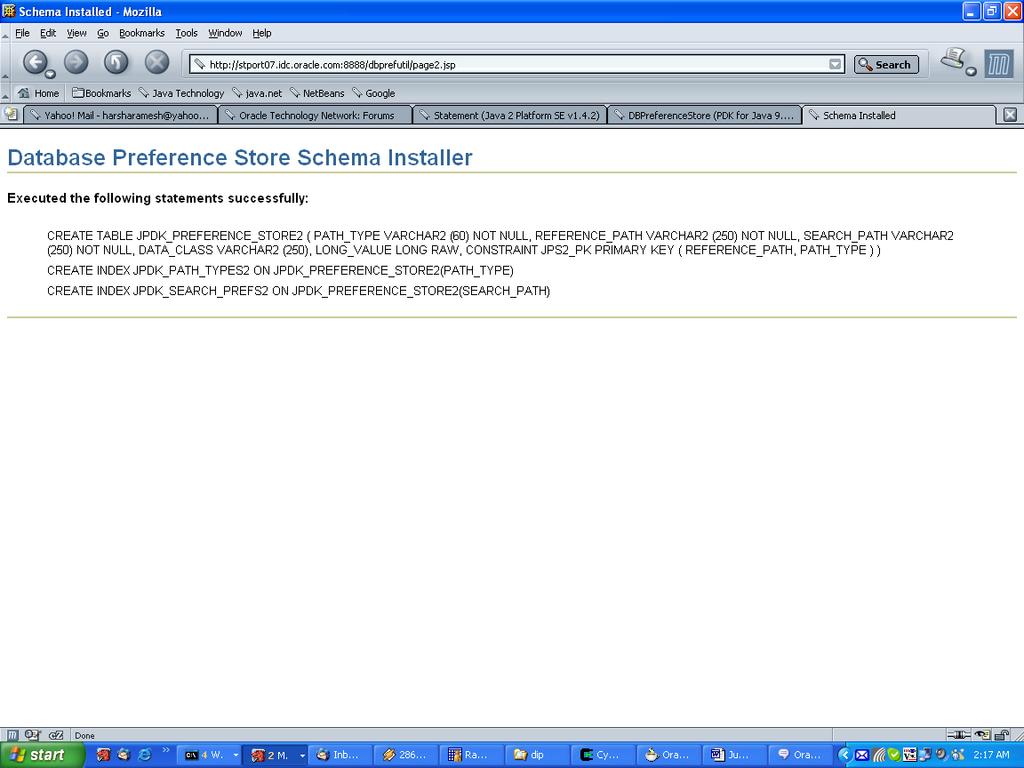
I am among the few people who are skeptical about working on the database, and prefer to work as much as possible via the web-based interfaces. Hence, I came up with a utility web-application (DbPrefStoreUtil), which installs the database schema required for DBPreferenceStore, on a remote database. This application is available on Knowledge Exchange under my personal folder (Search for contributor: harsha.ramesh). I have also included a detailed document on how one can setup a datasource via the OracleAS Enterprise Manager or the OC4J Admin Console on the standalone OC4J.
So the next time you decide to implement a portlet solution, try and see if you could provide a solution based on DBPreferenceStore.
Screenshots:
Rogue is a very innovative developer. One fine day, he gets a brilliant idea to portletize a very popular application. He publishes his portlet, and gets a very wide appreciation. The portlet is deployed on a major production site, which has thousands of employees using and customizing it, to suit their needs. The customer comes to Rogue with a very desired enhancement, and Rogue implements it and provides the new version to the customer.
But, Rogue had designed the portlet to use FilePreferenceStore for storing the user preferences. The customer, unaware about this detail, goes ahead and re-deploys the provider on his production system, and boom..... all the user customizations have been erased!!
Now, the customer, rather frantic, pulls the archived version, searches the web and identifies that he needs to copy the customizations folder back to the new deployment. Things finally work, and the customer realizes his folly, and learns his lesson the hard way.
Though the above case study is fictitious, it is a very common scenario that happens with people who are not well versed with the JPDK framework. The above scenario could be avoided if only the developer (Rogue here) had implemented the portlet solution to utilize database based preference store.
I definitely agree that it is easier to use the file system based preference store, as there are no additional configurations to perform when deploying the provider, but a little additional effort can go a long way. Using DBPreferenceStore for storing user preferences translates to the following:
- User preferences are independent of the provider deployment
- Easy upgrade / migration path – new portlet version, new container, different m/c, etc.
- Technically, you could support high-availability for these portlets, by deploying them on multiple containers, and sharing the sessions across the containers.
, And other benefits that I have missed out here.
Setting up a DBPreferenceStore is as simple as deploying an .ear file. All you need to do is:
- Install the JPDK preference store schema on a database.
- Create a datasource within the application server container which points to the above created schema.
- Make a reference to this datasource in your portlet’s provider.xml file.
Sample Example:
1. Provider.xml file configured to use FilePreferenceStore
2. Provider.xml file configured to use DBPreferenceStore
1. Provider.xml file configured to use FilePreferenceStore
<preferenceStore class="oracle.portal.provider.v2.preference.FilePreferenceStore">
  <name>EasyAccessPrefStore</name>
  <useHashing>true</useHashing>
</preferenceStore>
2. Provider.xml file configured to use DBPreferenceStore
<preferenceStore class="oracle.portal.provider.v2.preference.DBPreferenceStore">
  <name>EasyAccessPrefStore</name>
  <connection>jdbc/dbprefstore2</connection>
</preferenceStore>
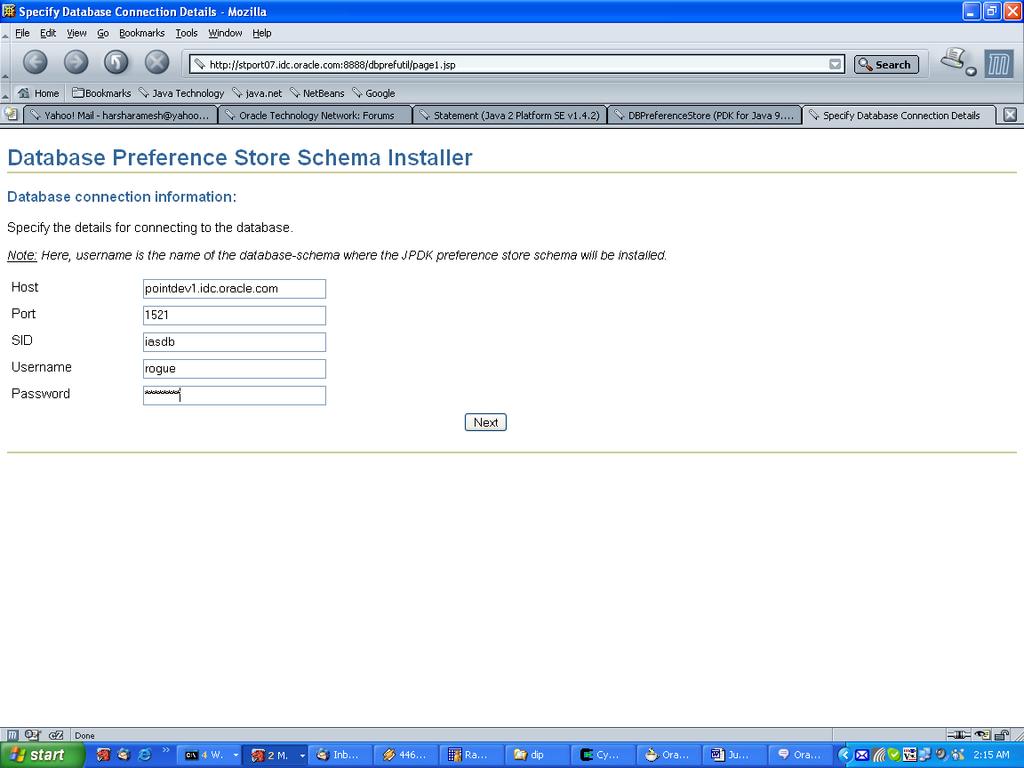
I am among the few people who are skeptical about working on the database, and prefer to work as much as possible via the web-based interfaces. Hence, I came up with a utility web-application (DbPrefStoreUtil), which installs the database schema required for DBPreferenceStore, on a remote database. This application is available on Knowledge Exchange under my personal folder (Search for contributor: harsha.ramesh). I have also included a detailed document on how one can setup a datasource via the OracleAS Enterprise Manager or the OC4J Admin Console on the standalone OC4J.
So the next time you decide to implement a portlet solution, try and see if you could provide a solution based on DBPreferenceStore.
Screenshots:
Subscribe to:
Posts (Atom)